🕒 8 min read
A single photon, far too small to see, hurtles through a physics lab. It passes through a barrier with two slits, its path invisible to human eyes. Yet, on a screen behind the barrier, it leaves a mark, a dot that seems to defy logic. Over thousands of repetitions, these dots form an interference pattern, the hallmark of waves. But here’s the twist: this isn’t just a physics experiment. It’s also a machine learning test. The photon, in this case, isn’t just behaving like a wave; it’s performing a task. This is the heart of a new intersection between quantum mechanics and artificial intelligence, where the same interference that puzzled Richard Feynman now powers a neural network. The experiment, described in a 2024, 2025 paper titled First Photon Machine Learning, is a glimpse into a future where AI might not need massive servers or GPUs to compute, it could run on a single photon, using the very principles that make quantum physics so strange.
The Double-Slit Experiment: A Century-Old Mystery Reimagined
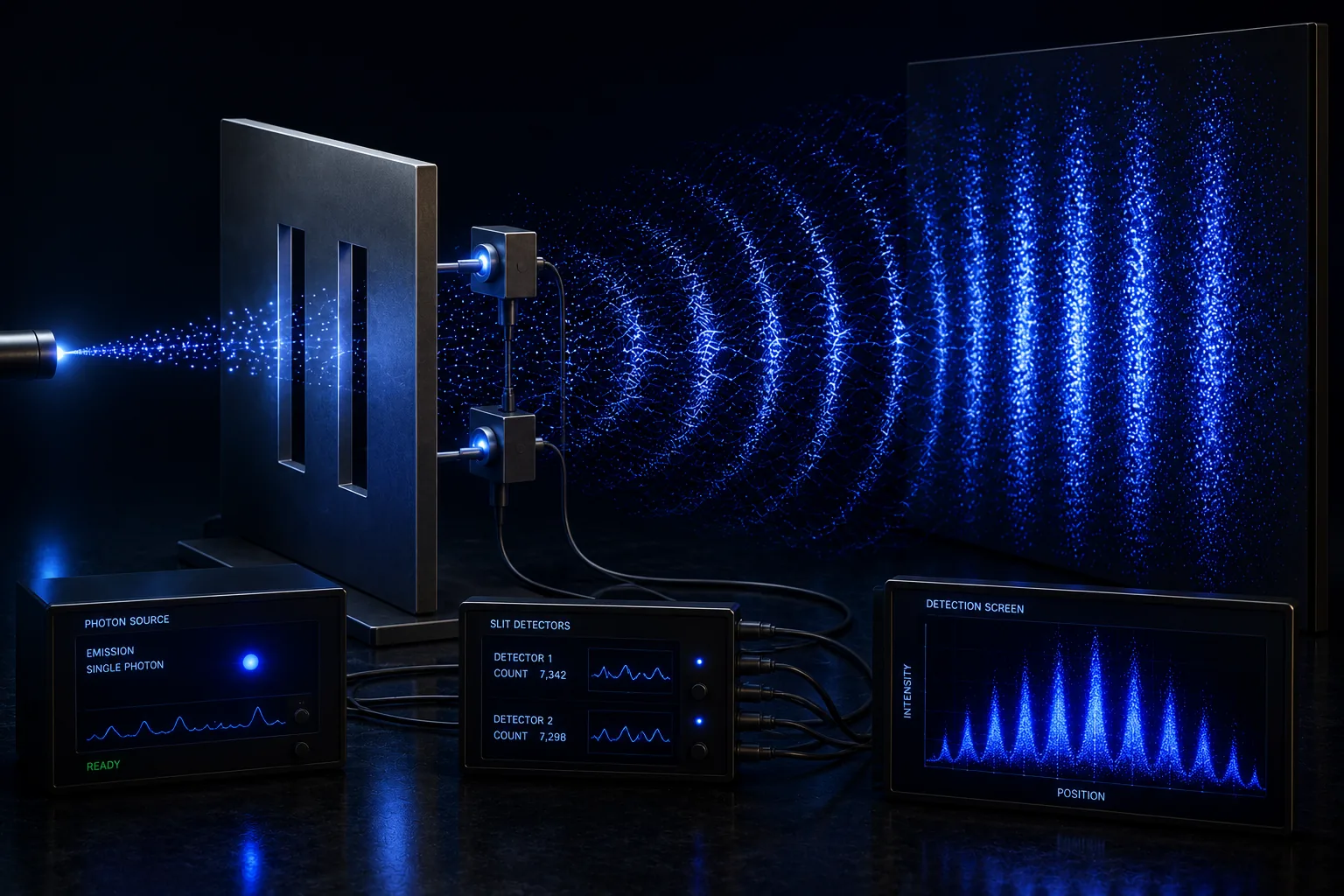
The double-slit experiment is one of the most famous in physics, a demonstration so foundational that Feynman called it “the only mystery” of quantum theory. The setup is simple: particles like electrons or photons are fired one at a time at a barrier with two narrow slits. Each particle arrives at a screen behind the barrier as a single dot, like a bullet. But over time, these dots form an interference pattern, bright and dark bands, suggesting the particles behaved like waves, passing through both slits simultaneously and interfering with themselves. This duality, where a particle can act as both a wave and a particle, is the cornerstone of quantum mechanics. The experiment becomes even stranger when a detector is added to observe which slit the particle passes through. The interference pattern vanishes, and the particles behave like ordinary bullets, revealing that observation changes the outcome. This phenomenon, wave-particle duality, has haunted physicists for a century, challenging our understanding of reality.
Now, researchers are using this same experiment as a platform for machine learning. In First Photon Machine Learning, scientists implemented a neural network using quantum optics, where a single photon could perform image recognition. The system achieved about 30% fidelity on the task, surpassing the theoretical limit of a classical system using the same tiny amount of light, which is around 24%. The energy cost per calculation was less than 10^-24 joules, a number so small it’s hard to fathom. This isn’t just a theoretical exercise. It’s a proof of concept that quantum interference, the same effect behind the double-slit pattern, can be harnessed for computation. The implications are staggering: if scaled, such systems could reduce the energy consumption of AI by orders of magnitude, potentially reshaping the field.
How Quantum Interference Powers a Neural Network
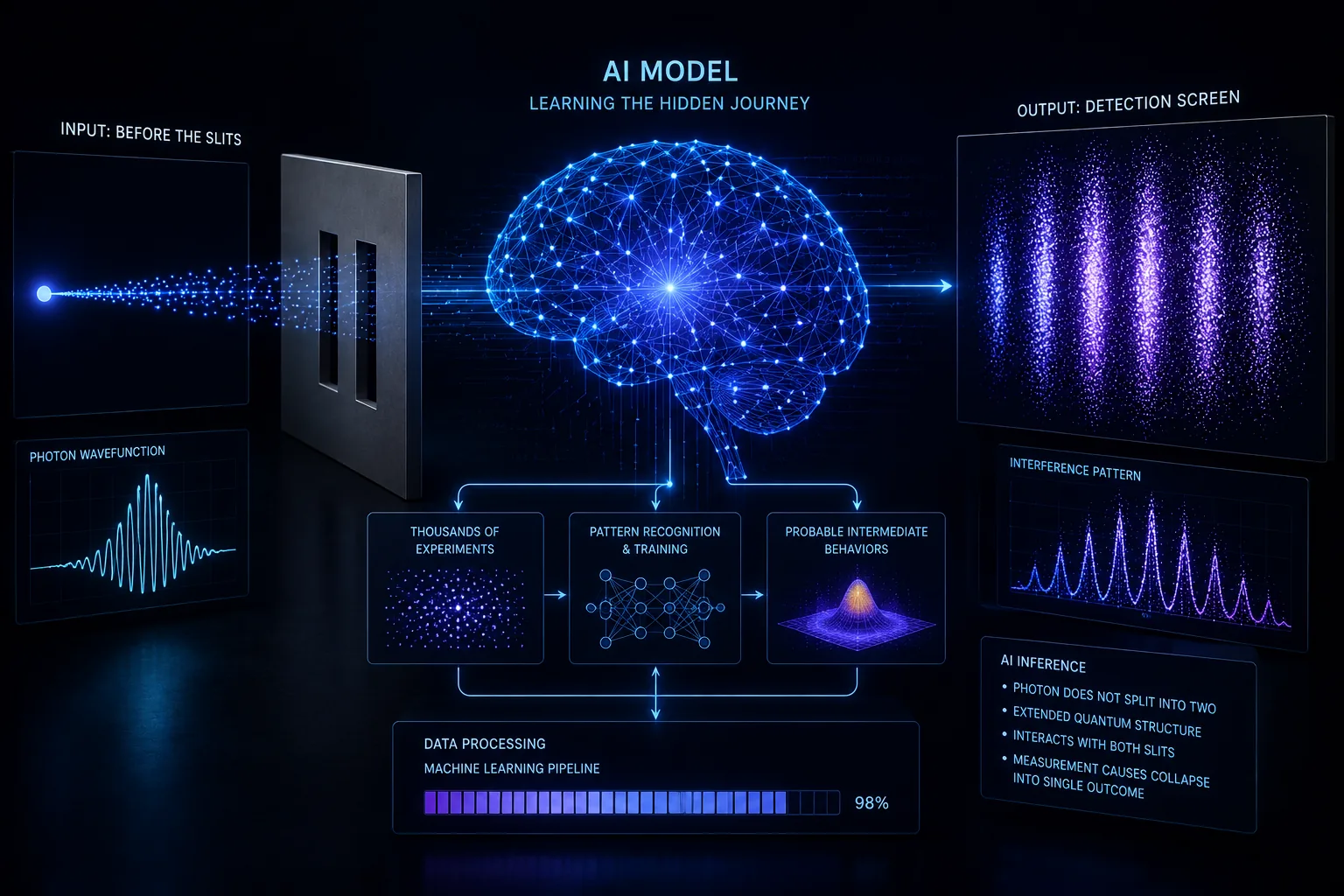
The key to this breakthrough lies in how quantum interference is used to process information. In classical machine learning, neural networks rely on vast amounts of data and energy to train models. Each layer of a network adjusts weights based on input, requiring massive computational resources. But in the quantum version, interference patterns themselves carry information. The photon’s wave-like behavior allows it to explore multiple paths simultaneously, effectively performing computations in parallel. This is similar to how a classical neural network uses layers to process data, but in the quantum case, the interference pattern encodes the result. The researchers trained the system to recognize images by adjusting the optical components of the setup, essentially “teaching” the photon how to distinguish between different patterns. The result is a system that doesn’t rely on traditional computing hardware but instead uses the physical properties of light to perform tasks.
This approach isn’t just about efficiency, it’s about redefining what computation can be. Traditional AI is built on silicon and electricity, but quantum machine learning could use photons and interference to perform tasks in ways that are fundamentally different. The energy savings alone are mind-blowing. Classical systems require vast amounts of power to run even simple tasks, but this quantum approach uses the same amount of energy as a single photon. While the current accuracy of 30% is modest, the paper emphasizes that the goal isn’t to outperform classical systems but to demonstrate a new paradigm. The real breakthrough is showing that quantum mechanics, once seen as an obstacle to computation, can now be a resource for it.
Why This Matters: Energy, Physics, and the Future of AI
The implications of this work extend far beyond the lab. Today, AI is one of the most energy-intensive technologies on the planet. Training and running large models consumes enormous amounts of electricity. Optical and quantum approaches that compute with interference instead of electrons could, in theory, slash the energy cost of certain calculations by orders of magnitude. This isn’t just a hypothetical benefit, it’s a practical one. If quantum machine learning can be scaled, it could make AI more sustainable, reducing the carbon footprint of data centers and making AI more accessible in regions with limited energy infrastructure. The energy efficiency of the single-photon system is a glimpse into what’s possible, even if it’s still in its infancy.
But the work also raises new questions in physics. A small group of physicists and AI researchers is using machine learning to probe double-slit-type experiments for hidden structure or subtler limits to quantum coherence. If some theoretical results hold up in real experiments, our understanding of where wave-particle duality begins and ends could need refining. This part of the research is still exploratory, but it highlights a fascinating possibility: AI isn’t just a tool for computation; it’s becoming a tool to ask new questions about the fundamental nature of reality. The double-slit experiment, once a demonstration of quantum weirdness, is now a laboratory for exploring the boundaries of quantum mechanics itself.
Quantum Neural Networks and the Road Ahead
Quantum machine learning isn’t just about energy savings, it’s about rethinking how neural networks operate. In classical systems, neural networks use layers of artificial neurons to process information, adjusting weights based on input data. In quantum systems, the interference of probability amplitudes (the wave-like quantities that the double-slit experiment makes visible) is used for classification, regression, and pattern recognition. The hope is that this approach could be more efficient for certain problems, particularly those involving high-dimensional data or complex patterns. While the current task of image recognition with a single photon is modest, it’s a starting point. Future work may explore more complex tasks, such as natural language processing or optimization problems, using quantum interference as a computational resource.
The challenges, however, are significant. Scaling up the system to handle more complex tasks will require advances in quantum optics, materials science, and machine learning algorithms. The current setup is highly specialized, relying on precise control of photons and interference patterns. Replicating this at scale would require new hardware and software, as well as a deeper understanding of how quantum systems can be trained. But the potential rewards are enormous. If successful, quantum machine learning could lead to a new generation of AI that is not only more powerful but also more energy-efficient, opening up new possibilities for scientific discovery and technological innovation.
A Blurring Line Between Physics and Computation
The link between the double-slit experiment and machine learning is real but early. Single-photon machine learning is a proof of concept, not a product; the accuracy figures are modest, and the tasks are small. The foundational-physics questions are open and speculative. What is genuine is that the boundary between the simplest, oldest quantum demonstration and the newest AI hardware is blurring. The same interference that puzzled physicists for a century is now being put to work as a computing resource, and AI is becoming a tool to interrogate the experiment itself. The mystery Feynman pointed to is no longer just something to wonder at; it is something engineers are starting to build with.
This is the essence of scientific progress: taking a phenomenon that once seemed purely theoretical and turning it into a practical tool. The double-slit experiment, once a demonstration of quantum weirdness, is now a laboratory for exploring the future of computation. It’s a reminder that the most profound discoveries often come from the intersection of disciplines, where the strange becomes the useful. As researchers continue to push the boundaries of quantum machine learning, the line between physics and AI will only grow thinner. And in that blurring, we may find the next great leap in technology, one that doesn’t just compute, but computes in a way that defies the limits of classical physics.
Sources, References & Attribution
This blog post summarizes and explains ideas reported in the cited source. It is an independent explanatory commentary and does not reproduce the original work’s text, figures, or tables. All rights remain with the respective authors or publishers. Readers should consult the original for full detail.
Primary Source: First Photon Machine Learning (arXiv 2410.17471, 2024, 2025)
Read the original: Original source