🕒 6 min read
When the James Webb Space Telescope opened its eye on the early universe, most astronomers expected it to fill in the blanks of a story they already knew. Instead, it keeps rewriting the footnotes. The first galaxies look brighter, busier, and more grown-up than the textbooks said they should be. That has produced breathless headlines about “broken cosmology,” but the truth is more interesting, and a lot less tidy.
Here is what Webb is actually showing us, and why the confusion is a sign of progress rather than a crisis.
The early cosmos was busier than the models predicted
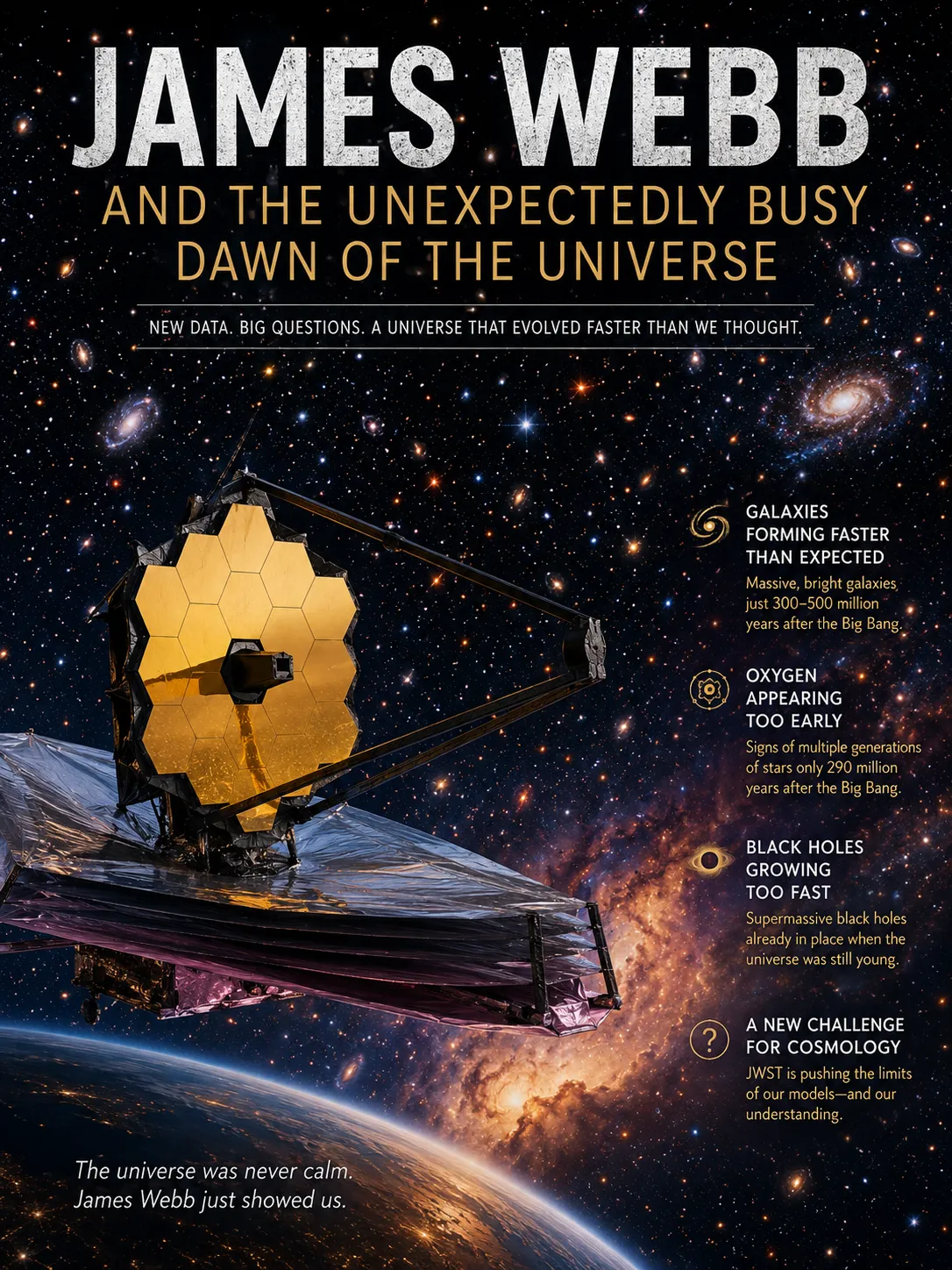
Webb is built to see infrared light, which is exactly what you need to study the most distant objects in the sky. As the universe expands, light from the earliest galaxies gets stretched into infrared wavelengths. Webb catches that faint glow, and the picture it has returned is startling.
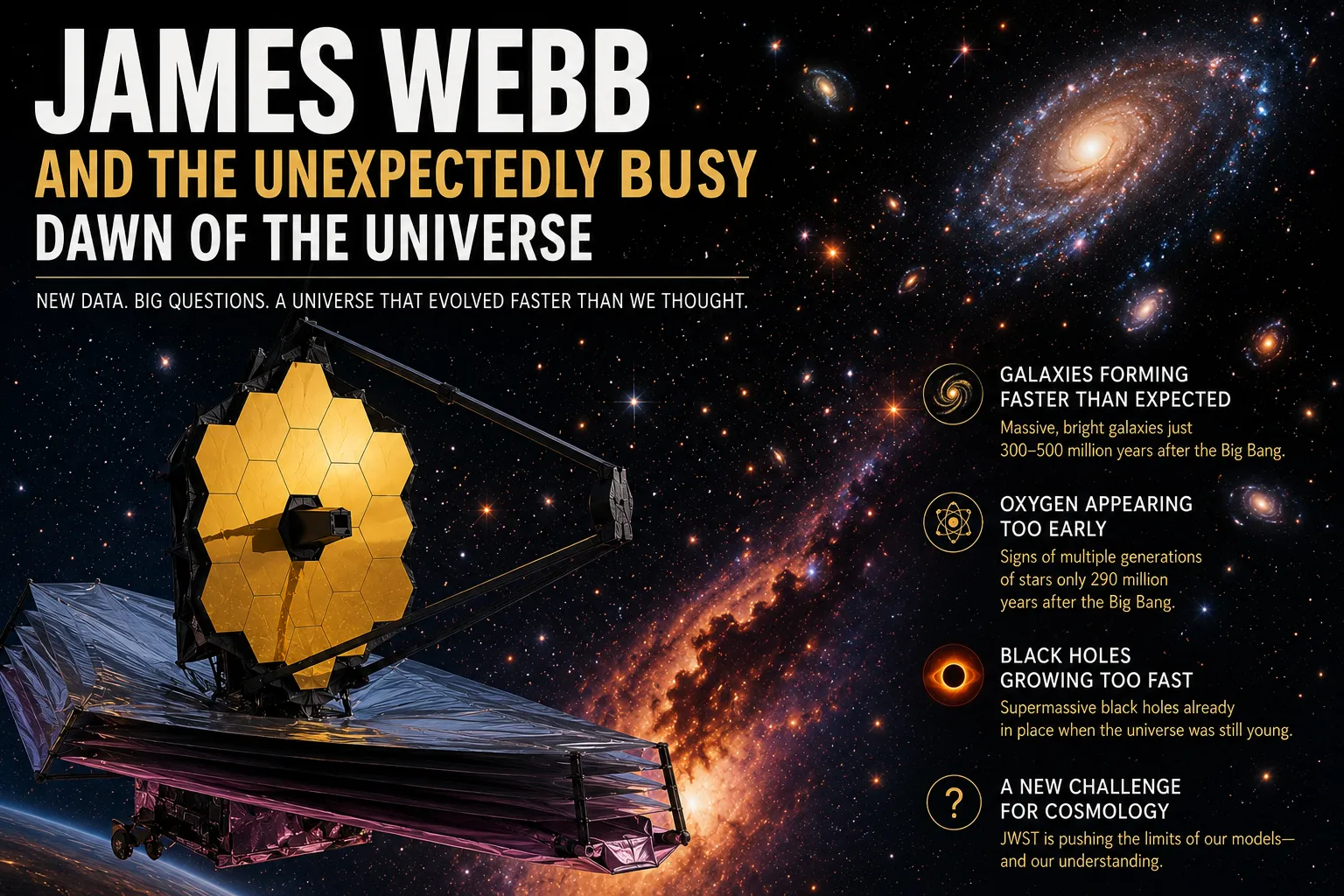
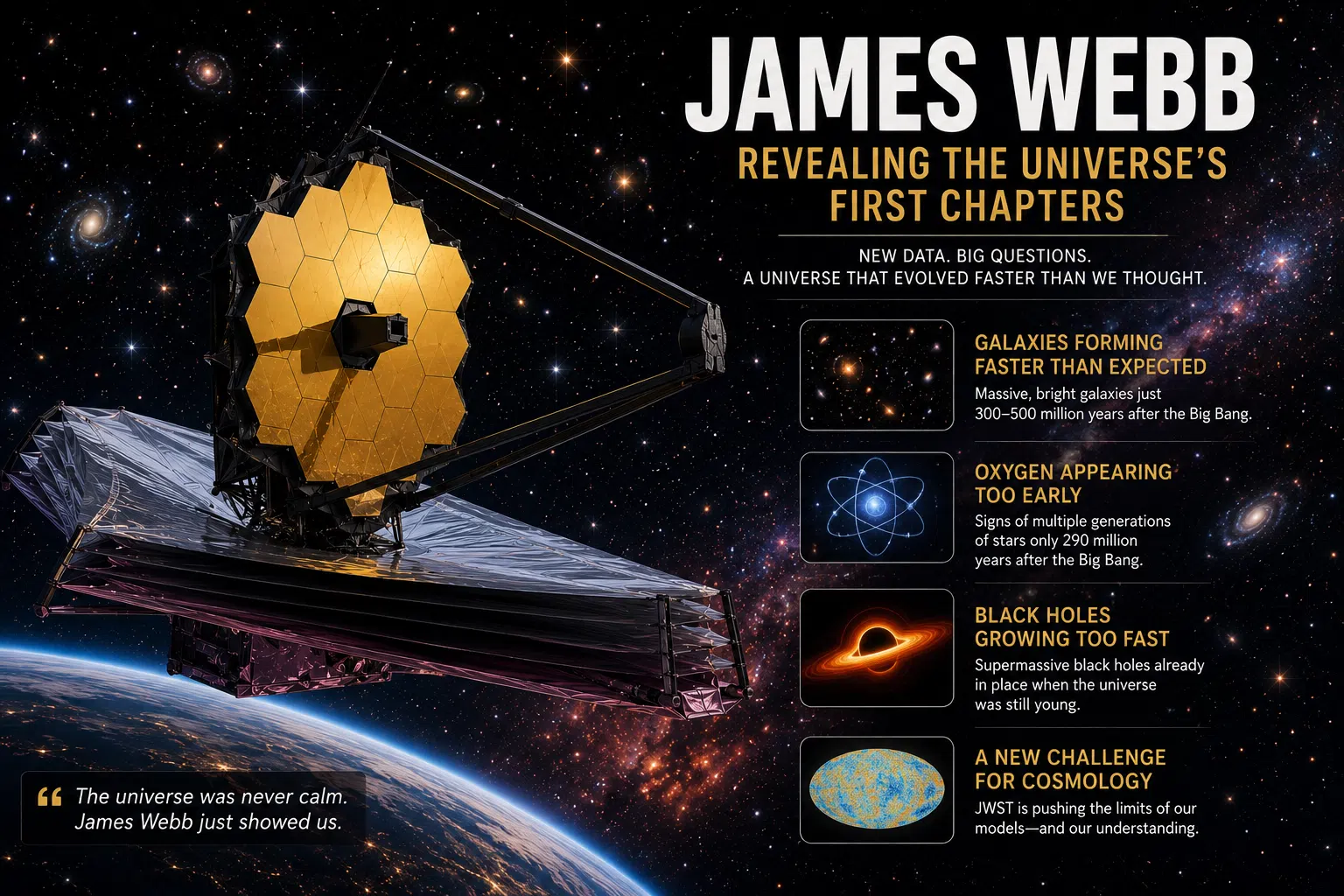
The current record-holder is a galaxy named JADES-GS-z14-0, confirmed in 2024 at a redshift of about 14, which places it near the very edge of what Webb can detect. We see it as it was roughly 300 million years after the Big Bang, a blink on cosmic timescales. It should be a faint smudge of primordial gas. Instead it is bright, sizeable, and chemically enriched. Astronomers later detected oxygen in it, an element that only exists after generations of stars have lived, died, and seeded their surroundings. By some estimates the galaxy holds about ten times more oxygen than models expected for its age.
Multiply that surprise across the sky. Webb is finding far more bright galaxies in the first billion years than anyone forecast. The standard model of cosmology, known as Lambda-CDM, predicted a slower, dimmer start. So either the universe broke its own rules, or our assumptions about how galaxies switch on need work.
How astronomers are explaining the surprise
The reassuring part is that scientists do not need to throw out the rulebook. Lambda-CDM still holds. What is shifting is the messier physics of how stars actually form. Three explanations are doing most of the heavy lifting.
Brighter stars, or just more efficient ones
One idea is that the earliest stars were intrinsically more luminous, perhaps because the first generation formed differently than stars do today. Another is efficiency. In the early universe, galaxies may have converted their gas into stars at close to maximum speed, instead of the leisurely, wasteful pace we see now. More stars, made faster, means more light, without bending any laws of physics.
A third option is timing. Early galaxies may have flickered, erupting in intense bursts of star formation, then going quiet, then flaring again over spans of tens of millions of years. Catch one mid-burst and it looks impossibly bright for its size. The honest position, for now, is that all three effects may be at work at once, in proportions we cannot yet measure.
The mystery of the little red dots
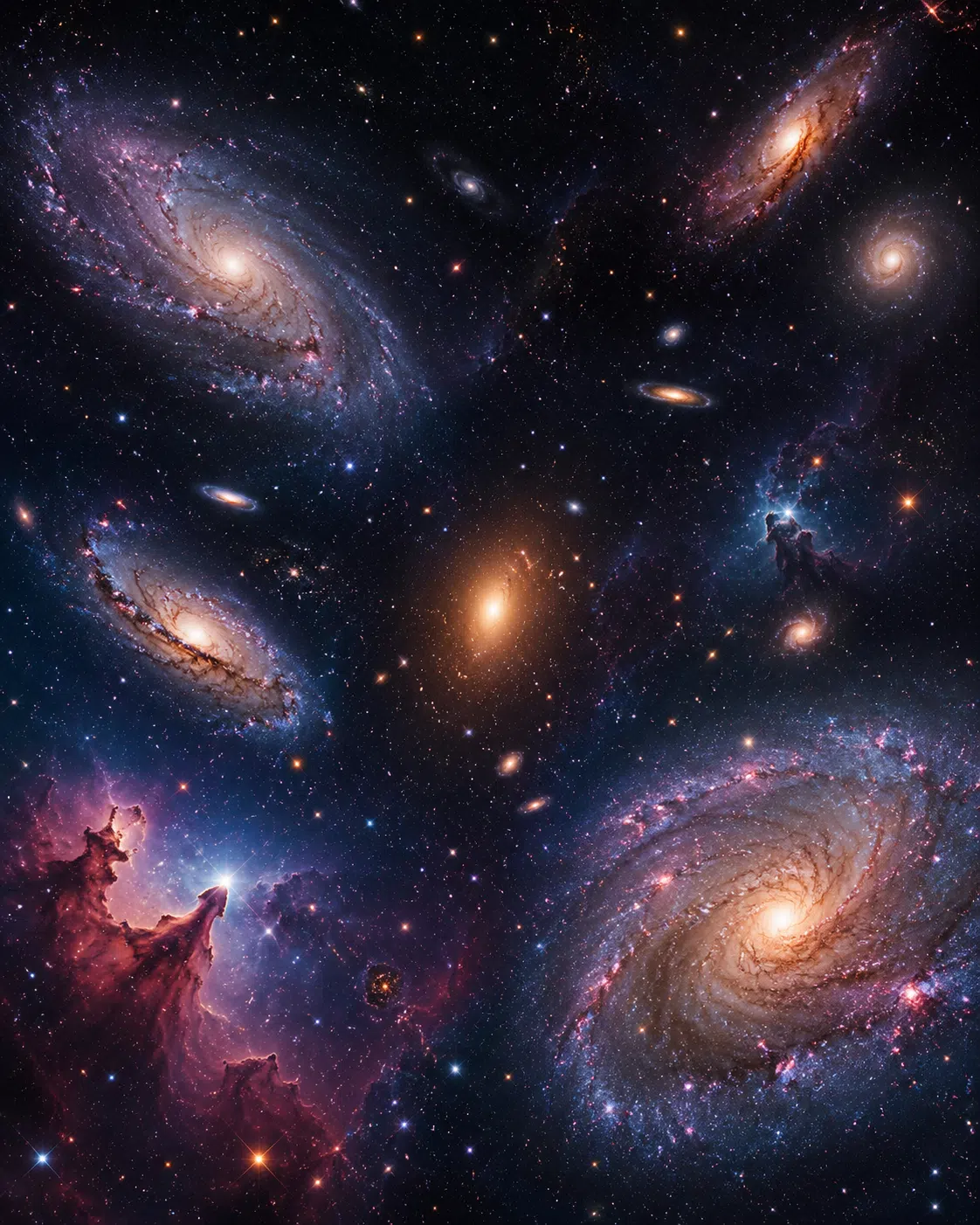
Then there are the objects that have genuinely stumped everyone: the little red dots. These are compact, intensely red points of light scattered through Webb’s deep images. They appear a few hundred million years after the Big Bang and largely fade by the universe’s busy middle age. Hundreds have now been catalogued.
Nobody is sure what they are. Some show signs of gas whipping around at thousands of kilometers per second, a hint that a growing supermassive black hole sits at the center. Others might be unusually dense knots of stars. One leading theorist has called them the single biggest discovery of the mission so far, not because we understand them, but because we do not.
Black holes that grew up too fast
Webb has also spotted black holes that seem far too massive for their age, including one in a galaxy seen about 470 million years after the Big Bang. That raises a chicken-and-egg problem. How do you build a giant black hole before there has been time to grow one the slow way? The favored answer is that some black holes started from heavy seeds, collapsing directly from huge clouds of gas rather than from the death of a single star. Evidence for that scenario, several researchers note, has been mounting.
Why this matters beyond astronomy
It is fair to ask why any of this should matter to someone who will never point a telescope at anything. A few reasons stand out.
First, this is what real science looks like in motion. The headlines that scream “Einstein was wrong” or “cosmology is broken” are almost always wrong themselves. What is happening is subtler and more honest. A powerful new instrument is exposing the gaps between our models and reality, and forcing those models to get better. Confusion, in this case, is the sound of knowledge being refined. One astronomer summed up the view of the first billion years as a “beautiful confusion,” which captures the mood better than any tidy headline.
Second, some of Webb’s apparent miracles come with asterisks. Distance estimates for the faintest galaxies still carry uncertainty. Gravitational lensing, where a massive foreground object magnifies the light of something behind it, can make a galaxy look brighter or closer than it is. In one striking case, a clump of light that looked like a single bright galaxy, nicknamed the Cosmic Grapes, broke apart under closer analysis into more than a dozen separate star-forming regions. Good science means resisting the urge to over-read a dramatic image.
Third, Webb is not the last word. Its findings will be cross-checked against other observatories, and the upcoming Nancy Grace Roman Space Telescope will survey wide swaths of sky to tell us whether these early bright galaxies are everywhere or just lucky finds. The story will keep changing, and that is the point.
For everyone watching from the ground, the takeaway is simple. The early universe was stranger, faster, and more crowded than we assumed, but the framework we built still stands, bruised and improved. James Webb has not torn up the story of how everything began. It has handed us a sharper pen.
Sources, References & Attribution
This blog post summarizes and explains ideas reported in the cited coverage of JWST early-universe research. It is an independent explanatory commentary and does not reproduce the original work’s text, figures, or tables. All rights in the original work remain with the respective authors or publishers. Readers should consult the original source for the full detail.
Primary Source: The Beautiful Confusion of the First Billion Years Comes Into View, Quanta Magazine (2024)
Publication / Repository: Quanta Magazine (science journalism), reporting on JWST results including the JADES survey
Read the original: Original source
License: Quanta Magazine, all rights reserved. Quoted facts and findings are attributed; no original text or figures are reproduced.